
@selixmyApplications (0)
I opened the AWS console homepage today and found this:
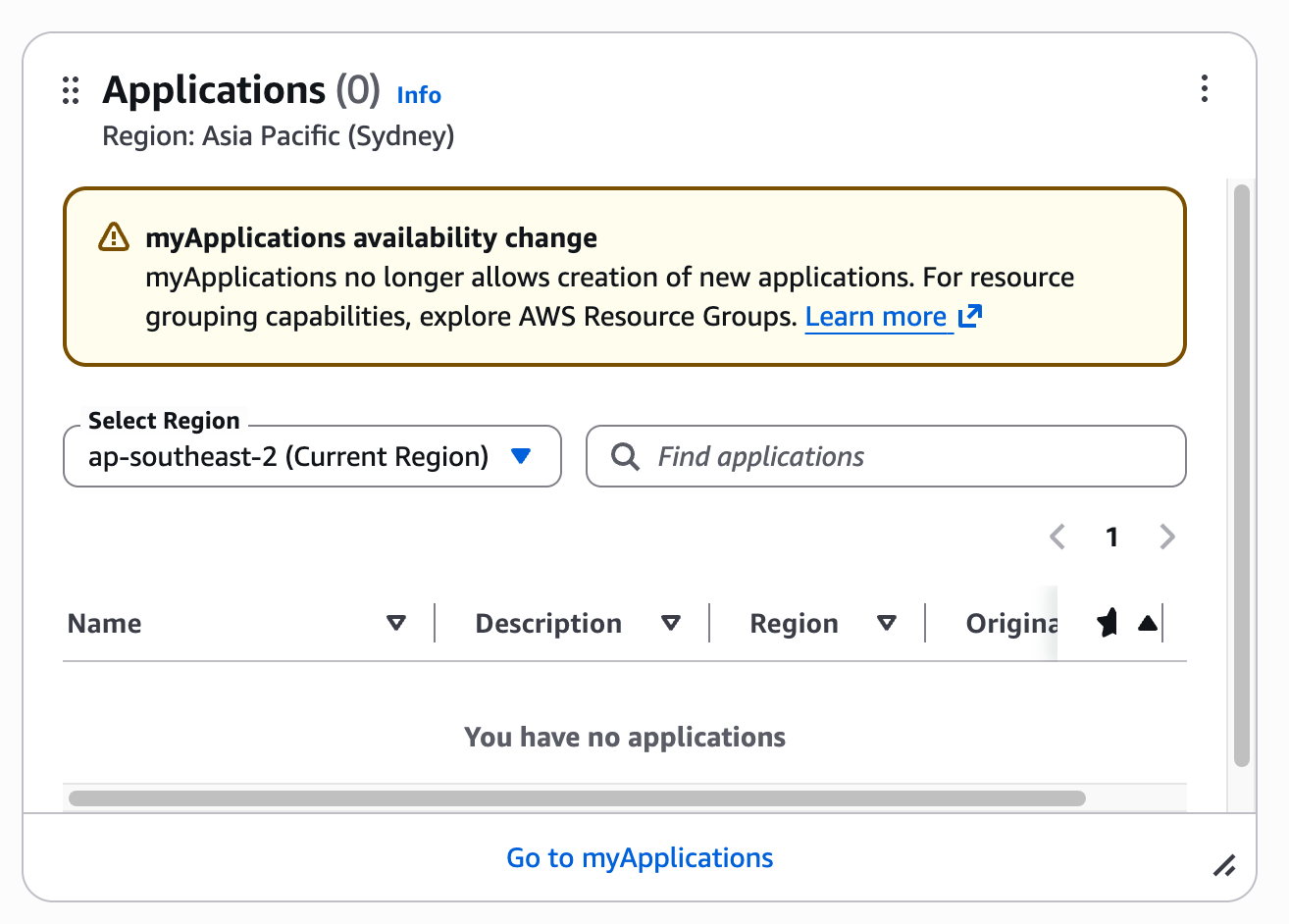
I don’t have any myApplications. I never have. And yet this widget has occupied pride of place on the console home since 2023. It’s now telling me that I can no longer create new applications. Dang it, maybe today would have been the day!
The widget is advertising a defunct feature; it knows I have no myApplications. Why not just auto hide it? Because no-one is left on the service team to do it? Because there are too many service teams to rally around to actually make this look nice?
AWS calls this an availability change, an impressively euphemistic way to say that it is killing the service. It never did the useful cross-region application view that the feature needed; instead, it asked users to keep a second, fussy, regional database of their own infrastructure up to date. It must never have achieved the traction its director needed to keep it funded. Now the feature is gone, and the empty widget has been left on Console Home to deliver the news.
This reminds me of the U2 album Apple pushed into everyone’s iTunes libraries. A well-meant thing parked in prime real estate, whether folks wanted it or not. The U2 album was at least playable. This is an empty, ugly widget giving its retirement speech.
I guess the original idea was sensible. AWS organises its console around AWS services, but an application might use Lambda, S3, DynamoDB, CloudFront, Route 53, alarms, logs, and IAM roles all at once. myApplications was supposed to provide one place to see the resources, costs, security findings, performance, and operational health.
That is the kind of feature that sounds obvious from the customer side but is going to complicated from the inside. The application record itself was regional, as was the resource group behind it, so an application in Sydney and Virginia was still two application records. That is an odd boundary for a company that has spent years encouraging customers to run in multiple regions.
What makes it more interesting is that AWS already centralises the parts it needs to centralise.
Cost Explorer sees costs across regions and accounts, and its API has one endpoint in us-east-1.
Resource Explorer can search tagged resources across regions and accounts, too.
I don’t know the internal history, but the customer-facing trade-off is clear enough. The data was there for a cross-region application view built from an application tag, Resource Explorer, and billing. It would not have been perfect: some resources cannot be tagged, shared infrastructure does not divide neatly, and cost-allocation tags need activating. But a useful, imperfect product sounds better than another registry for customers to maintain.
Tag implementation is up to each service team, and that AWS “tax” never gets real funding in OP1, unless a PM makes a really strong case for it. Hence why tag support can be so spotty across services and resources.
In practice, that meant registering an application, adding its preferred tag, and enabling enough surrounding services to make the dashboard interesting. Who wants another database in which to explain AWS to AWS.
AWS now recommends Resource Groups, useful tag queries over resources in one region but not quite the application view the original feature promised.
I removed the defunct widget. Next on the list now is:
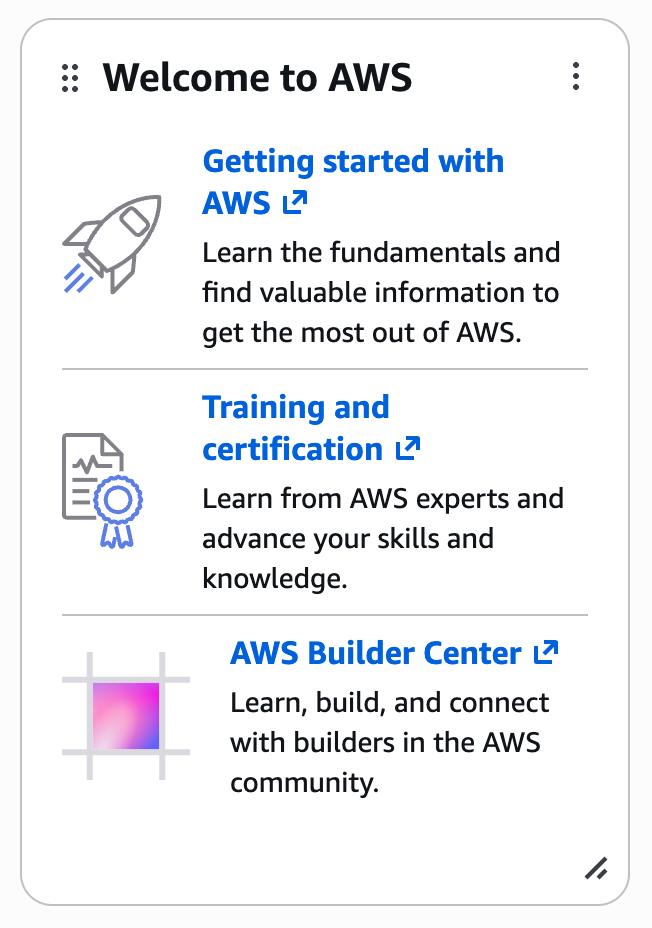
Welcome to AWS gets third billing on the home page. I’ve had an AWS account for twelve years, so either AWS thinks I am new, in which case this should probably be first, or it has noticed that I am not, in which case it could leave. Instead it sits in the middle ground reserved for default filler that nobody has quite got around to removing.
The third item is visibly out of rhythm with the first two, on the default AWS Console home page rather than some difficult edge case six screens deep.
Together the screenshots have the look of a page assembled from perfectly reasonable local decisions, without anyone doing the final pass for the person using it.
Each service owns their console widget, but seemingly nobody ends up owning the whole experience.